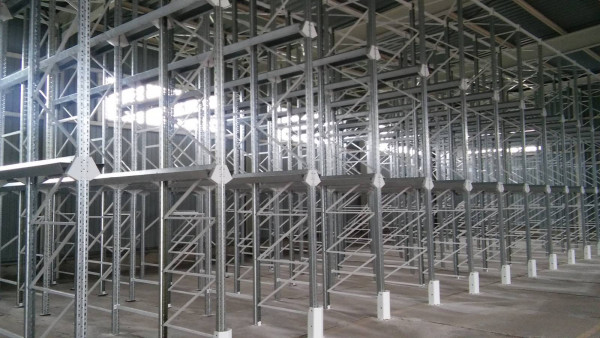
Drive-in racks (deep, drive-in, drive-in)

Drive-in racks (deep, drive-in, drive-in)

Code drive-in
5 1 0 5
1 1200 1200 1200
Height (mm)
up to 12000 мм.
Download channel width
1350
Pallet weight (kg)
2000
Tier pitch (mm)
75
Coating type
порошковая краска
Color
RAL 2004, RAL 9016
1 200 
Description
Files
Entry rack (deep walk-through, drive-in, drive-in) - this is a modern solution for storing large volumes of the same type of pallets.

In such there are no passages between the rows in the system.
Thus, the efficiency of using the warehouse space is increased by 6 times.
Such a storage system of stocks is more capacious than a pallet (frontal) system.
Equipment drives into the depths of the system for loading or unloading goods.

Suitable for placing products with the same characteristics, low turnover rates with long shelf life for use.
Warehouse optimization by 70-80%.

How shelving drive-in

Depending on the installation option, walk-through complexes may have:
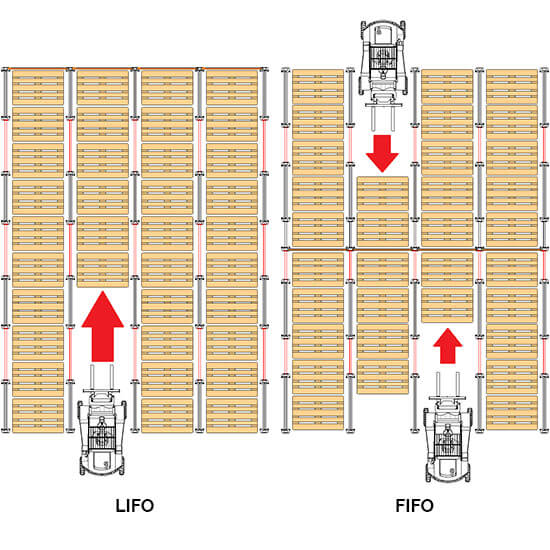
  • One-way (Drive-in) loading and unloading — the warehouse operates according to the  LIFO «last in & first out» principle, the process of loading and unloading goods is carried out on one side, such a system has found its application in warehouses, designed for the simultaneous storage of large volumes of long-term storage goods.
  • Two-way (Drive-Through) loading and unloading — the warehouse functions on the principle FIFO "first come – first out», this means that the first loaded pallet will be unloaded first. "Through" scheme – the best option for warehouses with goods with a limited shelf life.


Forklift Height Requirements

The loader or stacker drives directly deep into the entry rack channel and places the goods. Therefore, there are certain requirements both for loading equipment and the parameters of the rack structure.

A — Overall width of the loader.
There must be a minimum clearance B mm on each side between the loader and the vertical members of the rack.

Size C, distance between rack posts.

G — Loader operator protection width.

H — Minimum distance between cradles.
Minimum clearance between cradle and operator guard – 50 mm.

D and E — Base height and forklift protection.

F — Maximum lift height.
Must be at least 200mm over size I.